
Charting Paths of Respect, Resilience, and Wisdom
— By Rebecca Tavernini '11 MA
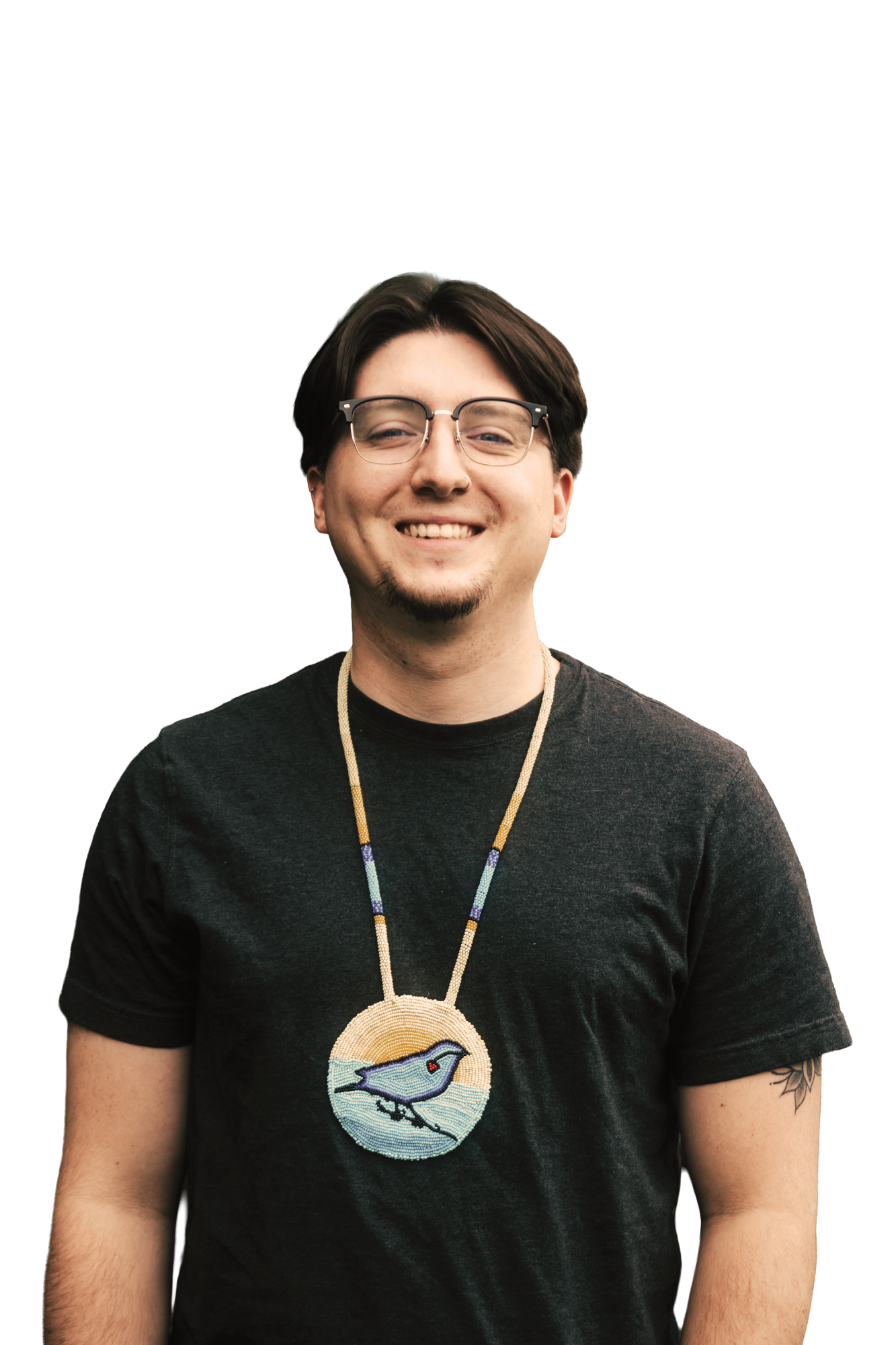
Bazile Minogiizhigaabo Panek grew up on the Red Cliff reservation in the northern tip of Wisconsin, surrounded by the Apostle Islands, in the hub of the Chippewa Nation. True to his heritage, he came to NMU—located on the ancestral homelands of the Anishinaabe Three Fires Confederacy—to pursue a degree in Native American Studies. And he is now on the trail of a master’s in Natural Resources Science and Management and Ph.D. in American Indian and Indigenous Studies at the University of Minnesota-Twin Cities— in the traditional homelands of the Dakota People.
One of the services of his business—Good Sky Guidance—is to help clients develop or improve land acknowledgments, shorter parts of which are stated above, and action plans to honor the Indigenous lands we inhabit.
“Right after I graduated from NMU, I saw that there were a lot of environmental organizations out there, and a lot of federal staff and state employees who wanted to work with tribal communities. They wanted to integrate Indigenous knowledge into their work, but they didn’t know how. And that’s the gap that I am trying to fill—to help people to do that engagement and integration in a good way—meaning that it’s respectful, but that it’s also effective as well,” Panek explained.
“In Ojibwe culture, we have spirit names or names that are given to us when we are at different times in life, but mostly when we are young. The name given to me was Minogiizhigaabo, which translates directly to “standing in the good sky.” So I used the good sky portion of my name to kind of represent myself in this consulting work, particularly in the guidance portion. I could have named it like Good Sky Indigenous Consulting or something very professional, but I thought guidance was more appropriate to how I work with my clients. They have a sincere desire to do this good work and I help guide them in the right direction. I’m not doing everything for them, because then what would they learn?”
He specializes in Ojibwe communities, but works all across the United States, often partnering with other tribal experts and pulling in “incredible knowledge systems.”
“There are some things about indigenous peoples that apply to all nations,” he said. “I think there’s always the deep care for the environment. Additionally, we all recognize that youth and elders are incredibly important in all of our communities.”
Some examples of his clients include:
- The Institute for Tribal Environmental Professionals at Northern Arizona University, where he helped lead the development of the Status of Tribes and Climate Change Report, encompassing all U.S. tribes, with 76 authors, eight chapters and 250 pages touching on topics such as Water Justice, Good Fire and Climate Change, and Seventh Generation: Young Leaders in Climate Action.
- An architecture and engineering firm that has developed a land acknowledgment for its Minneapolis office and conducted cultural awareness training for its employees to facilitate relationships between the company and tribal communities in Minnesota.
- The Cable Natural History Museum, where they collaborated to create an exhibit integrating Ojibwe knowledge and teaching methods: “Anaamaagon: Under the Snow,” which invites visitors to enter a hidden realm where mice play, weasels hunt and life depends on deep snow.
- A socially responsible nonprofit agriculture organization that helps communities keep concentrated animal feeding operations accountable to environmental policies and restrictions to ensure community water and lands aren’t polluted.
- Entities interested in cultural awareness trainings to learn to interact with tribal community members in a culturally respectful way by giving gifts, sitting down and listening to elders and developing a deeper relationship with them. These interactive, two-hour sessions are available in-person or virtually and can accommodate groups of any size.
- Working with Marquette-based Syncurrent (see page 16) to help Tribal Nations find, apply for and secure federal and local grants and funding. Panek noted: “While we were at NMU, Dhruv and I dreamed of running our own successful businesses someday and now we are at that point. Exciting times!”
- Good Sky Guidance also facilitates traditional Talking Circles for today’s issues. “A lot of the times, we don’t necessarily get a chance in Zoom meetings or in boardroom meetings to have a deeper discussion and conversation that is facilitated in an honorable way, respecting each other and allowing everyone the space to both talk and listen. By engaging in the practice we learn from the process, and work together to find answers
Panek sees positive strides in the way Indigenous cultures are treated today.
“I think that’s demonstrated by how busy I am! A lot of people want to do this good work and are coming to me to do so, and that’s a really exciting shift to see.
“There has been a lot of ignoring, silencing, excluding, but I think there has been a shift that changed to wanting to include, and now people are becoming more educated on how to actually include and how to engage with tribal communities. Environmental groups especially are seeing this as a necessary component of their work.”
Still, he says there remain many threats to Indigenous peoples and culture and knowledge. One being climate change. “There are these changing environments that we’ve had relationships with since time immemorial, but now these things are changing. Species are shifting. We’re losing culturally important species. Some trees aren’t regenerating as much as they used to. So we’re losing out on these aspects of our culture due to the changing climate.
“We also continue to face racism, of course, I think it is a continuous thing that we have to be resilient in the face of—it’s sort of a constant. But I think that Indigenous peoples have been incredibly resilient throughout the early stages of colonization and the continued stages of colonization that are still going on today. That resilience is palpable within our living and thriving cultures—century after century. Our guidance from spirits and through ceremony helps deepen our connection with the world around us and keep us grounded. We recognize that we have a responsibility to our future generations because our past generations have allowed us to practice culture and exist as an Indigenous person. So in turn, we have to act in reciprocity, to ensure that future generations will be able to do the same. That ties in with our environments as well. We’re incredibly intentional with our relationships with the land, we care for all of the beings, and take into account how they will experience the changes we want to make, or the practices that we have. We have always recognized that we need to take care of those beings so that in turn, they will take care of us.”
Panek experienced that generational connection and caring in NMU’s Native American Studies program.
“The professors gave us an incredible education and also a launching board to excel in our own ways in the Native American Student Association [NASA], which was an incredibly powerful group of students. I take a lot of lessons from my time at NMU, like the ability to work really hard at something that we want to happen. The recognition of Indigenous Peoples Day by NMU was an example of that. Good things take hard work.”
Through NASA, Panek and fellow students also initiated a unique process to change their organizational structure from a hierarchical framework of president, vice president, secretary and treasurer to a more equitable model in a medicine wheel framework.
“That took a lot of discussion within the organization—reframing things, imagining and working together to come up with this. It taught me how to facilitate engagement, get student buy-in and participation and think outside of a box that has existed for so long in these kind of administrative structures.”
“Professors like April Lindala in particular showed me that I can go further than I thought I could. I could work harder than I thought I could. I could excel further than I thought I could. And that was from her encouragement.”
Panek hopes to follow in her footsteps, inspiring others.
“My culture was and continues to be a big part of my life, and I’m also grateful to both of my parents who instilled in me that culture is extremely important, and our Indigeneity is something to continue to foster, indefinitely.”

Bazile (right) poses with an Indigenous elder