
Emily Lanctot and Sammie Hardewig in the DeVos gallery

Chipmunk, 2013 by Corrie Steckelberg.

Emily Lanctot pulling small framed painting of waterscape from shelf

Sammie Hardewig gently handles a small Japanese figure from collection box

A painting and poem in tribute to the U.P. "Moose Lift" via helicopter
Just inside of the main entrance to the Art & Design Building is the DeVos Art Museum. To the side of the back gallery is a door that leads into a storage room and to a card-entry door, which with the right credentials will open into a temperature- and humidity-controlled chamber that houses the permanent collection of over 2,500 objects.
Here, metal racks stretch toward the ceiling, loaded with objects such as vases, statues, a giant wooden mortar and pestle and sometimes… who knows what it is?
Labels on horizontal file drawers hint at treasures by Frank Lloyd Wright and“Dean of American Designers” William H. Bradley, who is credited with making the first Art Nouveau poster (at age 12 he apprenticed for a newspaper in Ishpeming). There are watercolor illustrations by Fletcher Martin for John Steinbeck’s Of Mice & Men and works by Charles Dana Gibson, who created the iconic Gibson Girl illustrations and went on to be editor and owner of Life magazine.
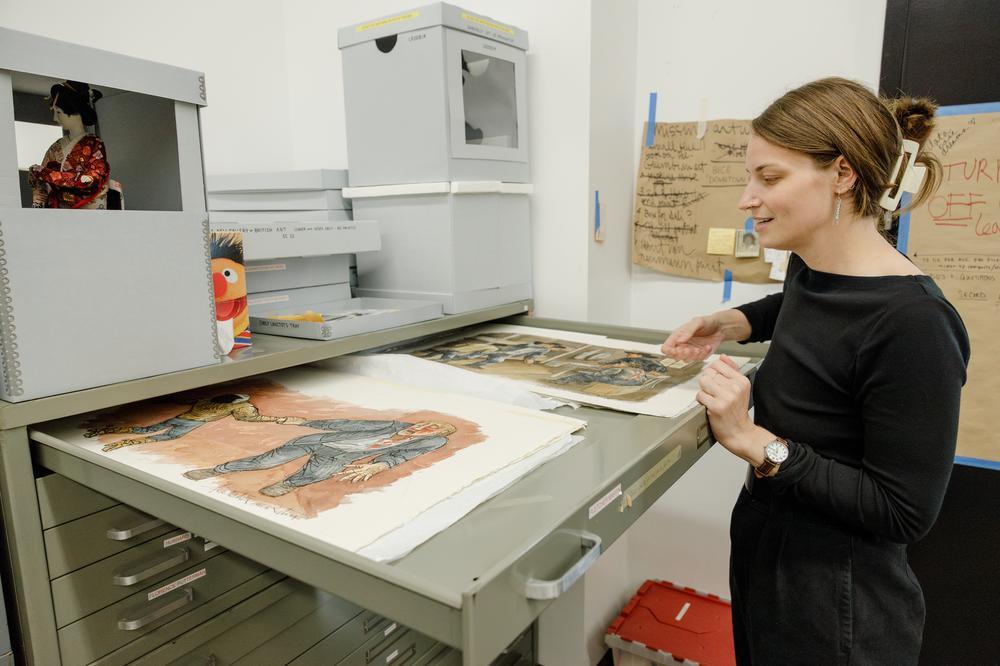
Boxes contain George Shiras negatives from National Geographic; John Munro and Mary Beecham Longyear’s European travel albums, lantern slides, postcards and depictions of turn-of-the century fashion. Others promise Masterpieces of Italian Art and Women in French Art.
The collection also represents some surprising pop culture icons, like a photo of a growling Iggy Pop and his pup, and a special-edition screen-printed poster by Mark Mothersbaugh of the band DEVO, who designed it for his solo exhibition held at the DeVos in 2009.
The museum mainly collects regional art; Indigenous art and craft; prints, photography and illustration; modern and contemporary design; and modern Japanese prints, artifacts and craft. It also maintains a study collection, which can be handled by visitors for educational programming. A small fund allows items to be purchased from special exhibits displayed at the museum, but most of the collection consists of donated pieces.
Visitors have a rare chance to see a number of items in “Critters: Representations of Animals in Art from the Permanent Collection,” at the museum until February.
Just a few samples of works on display in Critters are George Shiras’s pioneering night photography wildlife shots; a cat painting by Vida Lautner (accomplished artist and mother of iconic architect John Lautner ’33 AB, LC); a primitive looking sewn chipmunk sculpture by Corrie Steckelberg; a woodcut porcupine print by local artist Ben Bohnsak; an original illustration from a 1963 Sports Afield cover, part of a large collection of illustrations; and a few things people might be surprised to see, like an 1975 lithograph etching by Salvador Dali titled “Cybernetic Lobster Phone,” which is part of a suite of ten Dali prints in the collection.
“I think art has so many things that are important, like when we see somebody’s experience reflected through art, we understand that we’re not alone. We’re able to heal through art and grieve through art and restore relationships through it.”
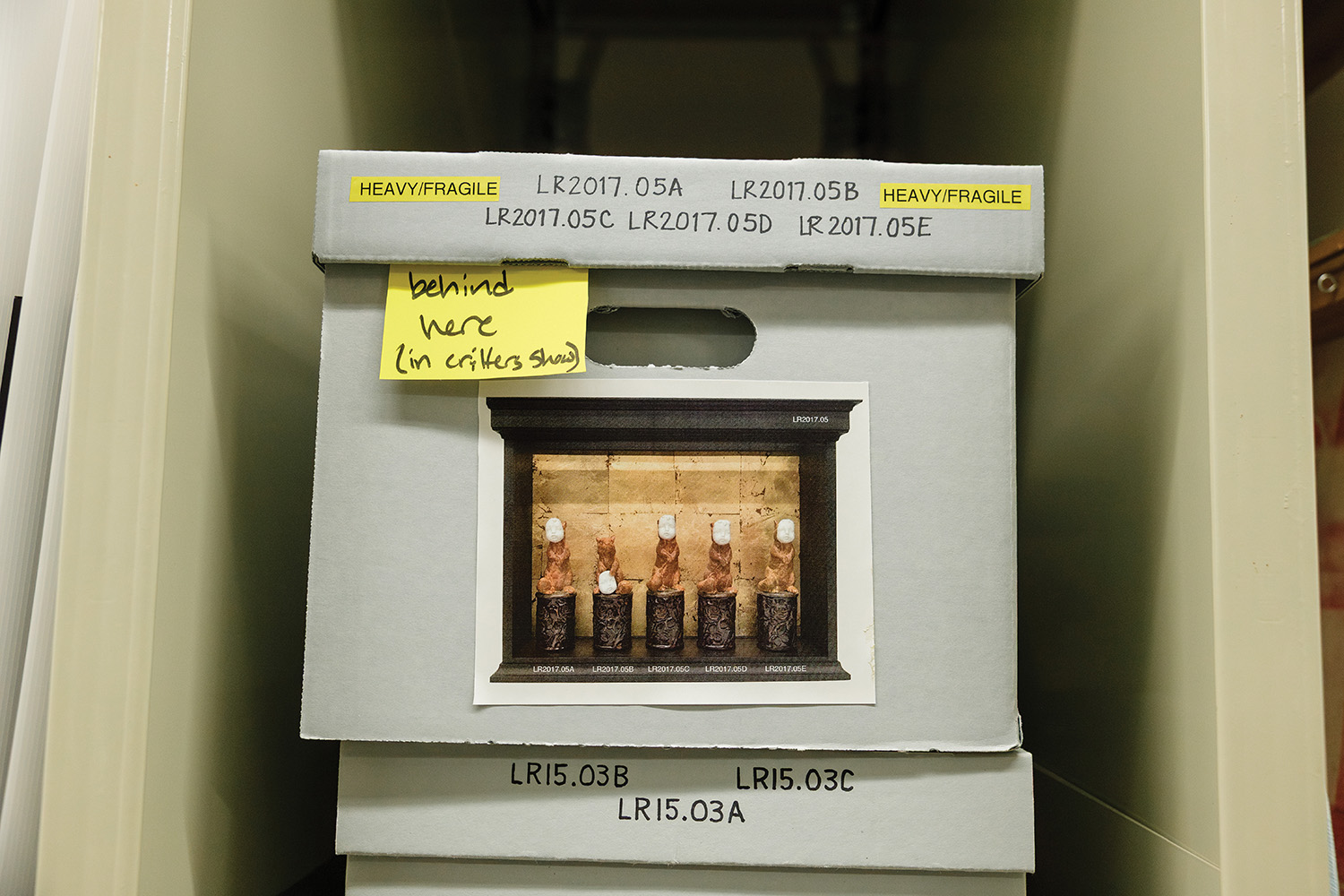
In the secure collection room along the back wall are large boxes with photos of the items inside, such as beaded moccasins, quill boxes, bone carvings and functional objects; and precise handwriting indicating their accession number. This protective care is credited to former NMU Art and Design Professor Diane Kordich and her friend, artist and DeVos volunteer docent Marilyn Keefe ’97 BFA, who have been volunteering to keep the collection in order for nearly 20 years.
“It's like going to church,” said Museum Director Emily Lanctot ’08 BFA. “Diane, after she retired, comes every Tuesday from 10 until 2 and builds archival boxes to house all of these objects. She learned how to use Photoshop so she could put the pictures on the side. Before, the pieces were just all on the shelves, getting dusty, freewheeling. Marilyn also makes custom cloth covers for all of the chairs in the collection. I always joke and call them my archive angels, or my Art Angels.”
The permanent collection goes back to Lee Hall Gallery, which was established in 1975 to mainly exhibit the work of faculty and students. Extensive renovations in 1988 allowed for better collection storage, and it was expanded to include outside donations, starting with silkscreen prints from Ralph Slovonko and Norman Pappas and Japanese prints and objects from Dr. Dorothy Lewis and Captain Arthur and Joy Bennett. “They fell in love with the culture and brought it back wanted to share it,” said Lanctot. And the collection just grew from there.
“As you can see, we're outgrowing this storage now. We really have to be careful about what we can accept. There are lots of people wanting to offer us great things, but if we can't properly store them, we can't properly accept them. So I'm always dreaming up a new storage facility that would be like ‘living storage,’ where things would be housed, protected in glass and have didactics with them, but they would always be visible.”
“We have classes come in, such as Human Geography or writing or K-12 students. I like to challenge them to engage in more sustained looking. I like to have them ask themselves: What do I see? How do I know? What else am I seeing or feeling? They often didn’t know they could ask an artwork questions.
“The art and questions really unlock stories for viewers. A lot of NMU students want to come back and look at pieces more closely, or at ones they may not have noticed, and it’s great that they can just pop in and do that, as the DeVos is the only art museum in the U.P. that is open year round—and it's free.
“Through art we are able to potentially find hope and solutions to questions that we've had in the back of our head, or open up our lives to new opportunity and into thinking about something beyond ourselves. Just slowing down and looking and being present with an object that somebody made that speaks to a moment in time and brings that moment forward into our lives is something really special.”
Annual donors of $100 or more receive reciprocal memberships to hundreds of museums and organizations nationwide via the ROAM or NARM cards.