
The Central Upper Peninsula and NMU Archives, located in the lower level of Harden Hall, is a repository for historical documents pertaining to the region and university. It is also a resource for genealogical research. Among its collections are the John D. Voelker papers, which document his career as a lawyer, county prosecuting attorney and Michigan Supreme Court associate justice, along with his activities as a writer and trout fisherman.
While the Archives is digitizing many printed materials and photographs to make them more publicly accessible, there are a couple of notable artifacts on its shelves related to Voelker: two bullets removed during the autopsy of a shooting victim at the center of the defining legal case of his career. Two other bullets were also stored in the same Michigan State Police envelope marked as evidence, residing in the Voelker files. Anatomy of a Murder, a book Voelker wrote under his pen name Robert Traver, is based on his experience successfully defending Lt. Coleman Peterson for the fatal shooting of Mike Chenoweth at the Lumberjack Tavern in Big Bay, Michigan. Voelker managed to secure an acquittal by claiming Peterson was gripped by an “irresistible impulse.” The book topped the New York Times Best Sellers list for nearly six months and was made into a 1959 Otto Preminger film by the same name, shot on location in Marquette County.
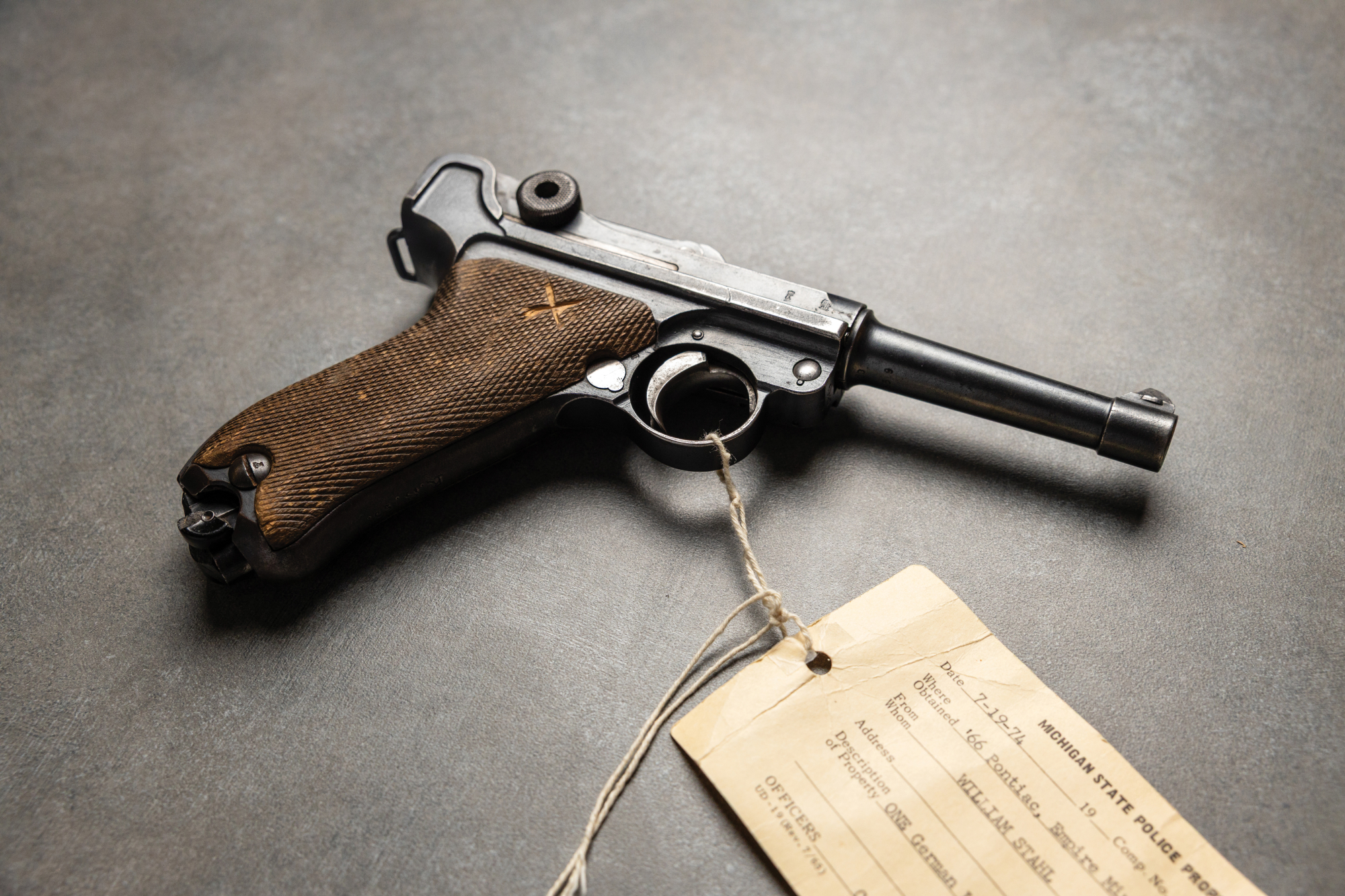
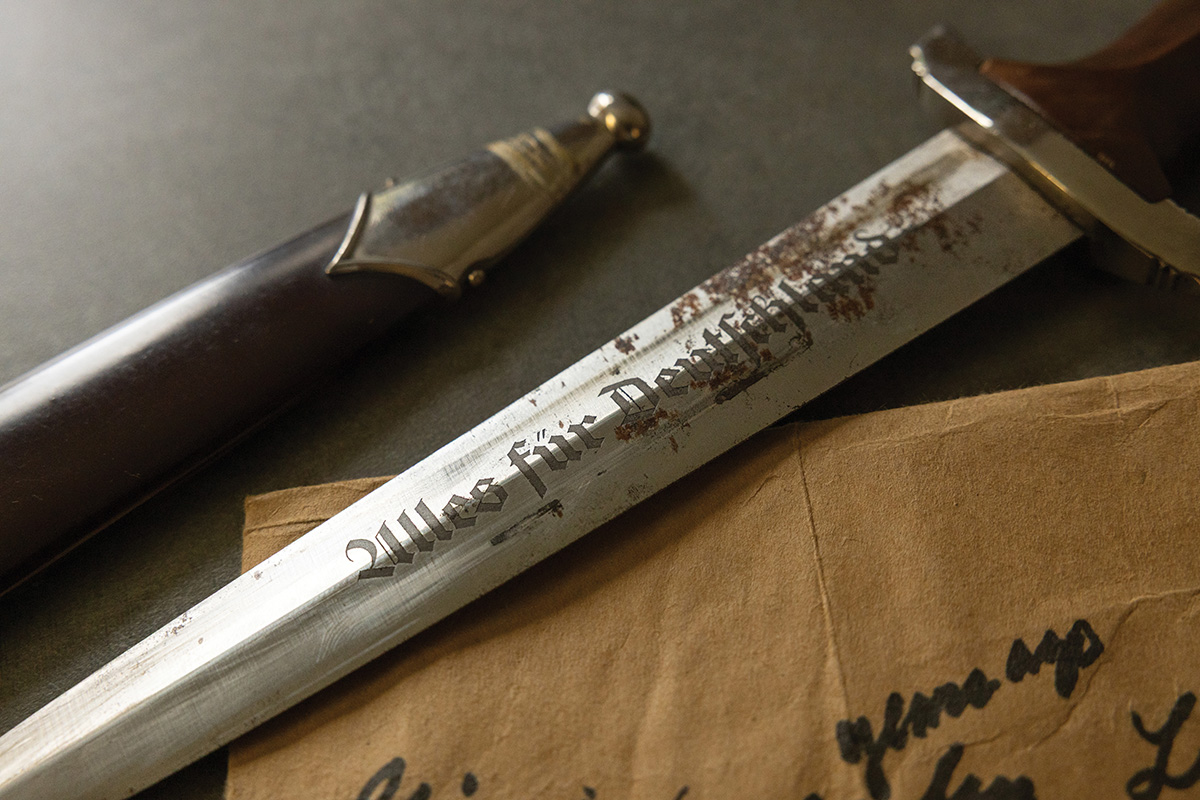
On a related note, two other items related to the murder case are securely stored at the NMU Police Department: the weapon, a Gesichert Luger 9mm automatic pistol; and what’s believed to be a WWII-era German dagger (Peterson was previously stationed there). Voelker’s handwriting on an envelope accompanying the items indicated he received both as “partial payment” from the defendant for his legal services. Th e gun was stored at Voelker’s camp and stolen when three young men broke into it in the early 1970s, but recovered from the trunk of a car by the Michigan State Police in 1974. (The evidence tag attached to the weapon is from that incident.) NMU Chief of Police Mike Bath '92 BS, '07 MA said the gun has an “X” on its handle, likely indicating it was evidence collected during the murder investigation and introduced during the trial. Voelker’s wife donated the gun and dagger to Northern. In the movie, Ben Gazara used an Army issue .45 Cal Automatic.
A document accompanying the gun states, “Lloyds of London was contacted to establish a value for insurance purposes and it was determined that the historical value of the weapon and the notoriety of the incident (book and movie) made the weapon priceless.” Bath said, "Because of the prominence associated with the case, we didn’t want to leave it just anywhere on campus. We take it out on occasion for display purposes at events, such as the culinary arts program’s Anatomy of a Murder-themed dinner a while back, but a police officer always accompanies it." There is also a non-operational replica of the gun that can be loaned out.
Other artifacts at the Central U.P. and NMU Archives include family films from the early 1900s documenting Greek life rush activities at Northern, along with scenes from Presque Isle Park and various locations in the Marquette area. The films and many other materials, including Northern yearbooks from 1910 and 1920-1980 and The Mining Journal newspaper archive, have been digitized through the UPLINK regional networkbased at NMU and posted at uplink.nmu.edu.
Among the first collections University Archivist Marcus Robyns acquired when he arrived at Northern in 1997 were the only surviving records related to the planning of Gwinn Model Town. In a Mining Journal story announcing his appointment at NMU, he stated that he was stunned there were no historical manuscripts documenting the iron mining industry, so he planned to make that one of his main areas of focus.
“When I drove there to get them, his wife was the only one home and handed me a couple bound volumes with all of this documentation on Cleveland Cliff s’ plans for Gwinn,” Robyns said. “They included correspondence from Warren Manning, a nationally renowned urban planner that William Mather had hired to create the model town. I asked where her husband got all this stuff and she said, 'Oh, he works at the county landfi ll.’ I couldn’t believe it, even though there have been many times I've heard that in my career. People just throw things away. CCI apparently pulled a truck up to the landfi ll many years ago and dumped the contents, including these documents.”
Surprises have also surfaced while processing donated materials, Robyns said. In one case, Civil War letters were squirreled away in a family’s papers, unbeknownst to the retired NMU employee who contributed the collection. In another, papers from the Maitland family, who used to manage a mine near Palmer, included correspondence from a World War I frontline surgeon stationed in France, reportedly a pen pal of one of the Maitland daughters. He survived the war and became a nationally renowned, pioneering orthopedic surgeon in Chicago.
The Maitland collection was acquired only because an observant employee at a transfer station called the local historical society to report that a woman drove up and dumped a stash of journals, diaries, letters and other documents related to the family and Ishpeming. The historical society then notified Robyns. He has developed a network in the U.P. to be on the lookout for materials that warrant preservation for future generations.
—By Kristi Evans