
Our Compass at Work
Translating Our Strategic Vision into Intentional Action
Our Compass is designed to evolve with our progress and changing needs. This page shares the stories of how NMU's campus community is translating our strategic vision into coordinated action across three Grand Challenges and 11 strategies. Through photos, articles, and updates, we invite you to follow the journey as faculty, staff, students, and community partners bring Our Compass to life.

Strategy 1.1. Embed health into all aspects of campus culture, across the administration, operations and academic mandates, and lead health promotion action and collaboration locally and globally, guided by the Okanagan Charter.
Emily Meier, Director of NMU CARE Management Services, speaks with teacher candidates about stress response and ways to support their well-being (December 4, 2025)

Strategy 1.4. Embed sustainable values into all aspects of the University, including curriculum, operations and external partnerships.
Students from Dr. Lucy Miller's (COB) PR 432 - Environmental Campaigns course present on waste reduction strategies and outreach campaigns for campus. Our Compass was used as a guiding document for the campaign development. (December 3, 2025)

Strategy 2.1. Expand work-based learning experiences that connect Wildcats and regional employers and organizations in order to increase opportunities for NMU graduates to launch or continue their careers in the Upper Peninsula and strengthen regional workforce capacity.
Northern Michigan University is enhancing its career preparation by offering expanded industry-focused events and discipline-specific exploration opportunities. These regional programming initiatives are designed to bridge the gap between students and the workforce through targeted, evaluated career support. By focusing on regional needs, the university aims to better prepare Wildcats for successful career launches within the Upper Peninsula and beyond. (September 15, 2025)

Strategy 2.2. Expand civic engagement and learning opportunities in order to empower students, faculty, and staff to address critical community issues and contribute to community and public good.
Northern Michigan University is implementing a comprehensive system to track and assess community-based partnerships to better guide institutional programming. This infrastructure is designed to enhance learning and collaboration for students, faculty, and staff while addressing critical community issues through shared information. (December 15, 2025)

Strategy 2.4. Assess NMU's comprehensive impact on the Upper Peninsula in order to determine and enhance its contribution to regional economic, community, health, and population outcomes.
Representatives from Public Sector Consultants present preliminary findings from NMU's Regional Impact Assessment sector-based focus groups; more than 70 participants from 7 community sectors participated. (January 15, 2026)

Strategy 3.1. Create a culture in which High Impact Practices and Experiences (HIPEs) are utilized, assessed, and promoted in order to enhance student engagement and increase retention.
DRAFT - Study abroad is a High-Impact Practice and Experience (HIPE) because, when intentionally designed, it delivers the kinds of learning that research consistently links to student success. HIPEs demand meaningful time and effort, extend learning beyond the classroom, require substantive engagement with faculty and peers, encourage collaboration across diverse perspectives, and give students the opportunity to apply knowledge in real-world contexts.
NMU's International Programs Office supports Wildcats in accessing programs in more than 50 countries, with options ranging from semester-long immersions to faculty-led and service learning experiences. Through these opportunities, students develop intercultural competence, critical thinking, and the career readiness that comes from learning in and engaging with the wider world. Visit the NMU International Programs Office Study Abroad website to learn more.

Strategy 3.3. Meet students' unique educational needs throughout their lifetime through developing flexible educational pathways and credential options based on the changing needs of students and the public.
Dr. Steven VandenAvond presents on NMU Evergreen. Evergreen is a flexible platform offering online degrees, certificates, and workforce training for lifelong learners. It is designed to help students build new skills or finish degrees without pausing their personal or professional lives.(January 15, 2026)
Follow the Journey
Stories of Our Compass at Work
The Backbone of Northern Michigan University's Sustainability
By: Daniel Wolski
NMU Vision: Like the lake that inspires us, Northern Michigan University will be known as Superior, in the ways we support our people, partner with our place, and realize the potential of all our students.
This article is part of a series highlighting progress on Our Compass, NMU's strategic plan. Strategy 1.4 challenges us to embed sustainable values across curriculum, operations, and partnerships. Here's what that looks like in practice.
Northern Michigan University earned a 91 out of 99 on the 2026 Princeton Review Green College Rankings, placing NMU among the highest-rated institutions in the nation for sustainability
What Makes a School Sustainable?
The Princeton Review scores schools on a 60–99 point scale based on three key pillars: student quality of life, career preparation for the clean-energy economy, and overall environmental responsibility. While most institutions are invited to participate, final ratings are determined by expert weighting of survey data, with a baseline score of 60 assigned if information is insufficient.
To streamline this process, the organization partners with the Association for the Advancement of Sustainability in Higher Education (AASHE). Schools utilize the Sustainability Tracking Assessment & Rating System (STARS) to report their data, which reduces administrative burden while ensuring sustainability ratings remain accurate and updated annually.
Key Evaluation Criteria
The final Green Rating score is determined by analyzing several specific operational and academic factors. These include a school’s waste-diversion rate, its use of renewable energy, and the availability of environmental studies programs for students. To read the full list of questions asked, visit the Green Rating Methodology.
NMU’s Path to 91
Northern Michigan University's high ranking is the result of several transformative initiatives designed to align campus operations with environmental values. A major driver of this success is the university's commitment to achieving carbon neutrality by 2050, supported by the use of SIMAP software to publicly track and report greenhouse gas emissions. These efforts have already led to a reduction in the campus carbon footprint by over 30% since 2010. Additionally, the Board of Trustees has taken a significant institutional stand by pledging to fully divest the university’s endowment from fossil fuels by 2028, while at the same time increasing sustainability-related investments.
On the academic and operational fronts, NMU has integrated sustainability into the core of its mission. Approximately 25% of the university’s graduates now come from programs with the sustainability focus and 20 different academic departments offer related coursework. Leadership in these areas is coordinated by a dedicated Associate Vice President of Sustainability and a Sustainability Advisory Council. Daily operations also reflect this commitment through a campus-wide single-sort recycling program and the use of a 30 panel solar array that generated 17,633 kW of electricity of clean energy in 2023.
Student-Led Sustainability Practices
Much of Northern’s success is driven by an active student body that leads several key organizations and projects on campus. A cornerstone of this involvement is EcoReps, a peer-to-peer education program where students organize events like monthly clothing swaps, “Mend-it Monday” repair workshops, and zero waste challenges at athletic events. EcoReps also helps manage the Green Fund, an optional student-paid fee that has provided over $120,000 for student-led projects such as the campus rain garden and the large solar array near the SHINE building.
Students also play a vital role in the university’s waste management efforts through several specialized programs. The Compost Crew consists of student workers in the Northern Lights Dining hall who help divert an average of 400 pounds of food waste from the landfill during every lunch and dinner shift. The food waste is sent to Partridge Creek Compost to help create a more sustainable future. The NMU Hoop House, a student-led collaborative learning center, also participates in smaller scale composting while growing fresh produce for the on-campus food pantry.
Beyond these programs, a diverse range of student organizations allow students to focus on specific environmental interests. The Conservation Crew organizes local trash clean-ups and habitat restorations projects, while groups like the Apiculture Club focus on honeybee education and Green Athletics promoting sustainable changes within the athletic department. Together, these student-led efforts ensure that sustainability remains a hands-on, community-driven priority at NMU.
If you’d like to learn more about sustainability on campus, visit the Sustainability Hub for Innovation & Environment (SHINE) dashboard.
Sustainability in the Classroom and Beyond
At Northern Michigan University, taking care of Marquette's unique environment is woven directly into academic experiences. While many schools offer green initiatives, NMU stands out by ensuring these values reach the classroom, with over 20 different departments offering specialized coursework. This way of learning from many different areas allows students in programs ranging from Environmental Studies to Sustainable Business to gain professional expertise in modern tools like Geographic Information Systems (GIS). By the time of graduation, a quarter of the student body has completed a degree program rooted in sustainability, preparing them to lead in the emerging clean-energy economy.
These academic lessons are reinforced through “living laboratory” experiences that turn the campus itself into a research site. Students step outside the lecture hall to engage in native plant restoration at the outdoor learning area or study sustainable agriculture at the NMU Hoop House. Additionally, the student-led Green Fund empowers students to pitch and fund their own environmental projects. Whether through an internship or hands-on field trips, these opportunities transform passion into practical, real-world impacts.
Throughout this combination of the school’s dedicated goal, student-led action, and academic implementation, Northern Michigan University continues to prove that a sustainable future is built one student at a time. While our current score of 91 reflects years of hard work, we are not slowing down; our campus community is already collaborating on new initiatives to push sustainability efforts even further and achieve an even higher score in the coming year.
The Benefits
Attending a sustainable university like Northern Michigan University fundamentally reshapes the student and staff experience, fostering a culture where personal wellbeing is inextricably linked to the health of the environment. By integrating these values into daily life, Northern creates a supportive community that prioritizes care over convenience. This is felt in the collaborative spirit of events like the "Mend-it Monday" workshops, which encourage a mindful approach to ownership, and the shared sense of purpose found in the student-run Hoop House that provides fresh produce to peers in need. These programs do more than just reduce waste; they build a resilient network of people who value the long-term vitality of their local ecosystem.
Beyond these immediate cultural gains, the university’s commitment to sustainability provides a unique framework for personal and professional growth. Students find themselves in an environment where ethical investment and environmental responsibility are not just abstract concepts, but institutional pledges that align with their own values. This alignment creates a profound sense of institutional trust, as seen in the university's transparent carbon tracking and its bold commitment to divest from fossil fuels. Ultimately, this holistic approach ensures that the university doesn't just produce skilled graduates, but conscientious leaders who carry a grounded, community-focused worldview into their future careers.
With the many majors and classes focused around sustainability and the environment, no matter what field a student chooses they will have hands-on experience with sustainable practices. With most businesses now being more centered on helping the environment, Northern preps its students for jobs and careers that make a big impact on the future of our planet.
Evergreen
By: Daniel Wolski
NMU Vision: Like the lake that inspires us, Northern Michigan University will be known as Superior, in the ways we support our people, partner with our place, and realize the potential of all our students.
This article is part of a series highlighting progress on Our Compass, NMU's strategic plan. Strategy 3.3 meets learners where they are throughout their lives. Here's how NMU is expanding pathways to credentials.
For over decades, Northern Michigan University has operated under a ‘60-year curriculum.” This approach supports opportunities for non-typical students to continue their education in a non-typical kind of way. However, this opportunity needs to be scaled to support the needs of the community. That’s when Evergreen was born. For people already in the work force wanting to continue their education in order to level up in life.
A Process in the Making
An Idea
To scale something is a challenging task. It is even more difficult when what is being rebuilt is already successful. How do you fix something that's not broken? That is what the NMU Global Campus was asked to do.
The goal was to make it easier for people in the trades, first responders, healthcare workers, stay at home parents, real estate agents, or anyone wanting to better their skills while bringing their working experience with them.
It Begins with a Blitz
It takes a team for a great idea to come to life. For Evergreen, it took more than a team. Members from the community, students, staff and faculty, and other partners all played a role in building Evergreen. Extended Learning leaders from NMU met with marketing experts from Carnegie Higher Education for a two-day creative strategy blitz.
In 2016, Northern Michigan University established its Global Campus to provide online and distance education programs specifically designed for busy adults and students unable to attend the Marquette campus. To strengthen its presence in the competitive online market, NMU partnered with Carnegie Higher Education (formerly Sexton) to focus on lead generation and digital strategy for the program. Carnegie and NMUs Extended Learning Team came together to brainstorm strategies for a creative platform to better engage and serve the NMU Extended Learning audience. On the agenda; develop a deep understanding of NMU Extended Learning's identity and audiences, examine Gen X, Millennials, Gen Z, and Gen Alpha media trends, test messaging and visuals, and to map strategies for more distinctive, effective creative expression. Why should these non-typical students come back to school or take additional classes/courses? How do we communicate the benefits of doing so?
To help define Northern Michigan University’s identity, workshop participants were guided through a series of questions describing the institution and its Extended Learning division. They explored foundational questions such as: How would you describe NMU as a whole? What about Extended Learning? What does the division do better than anyone else?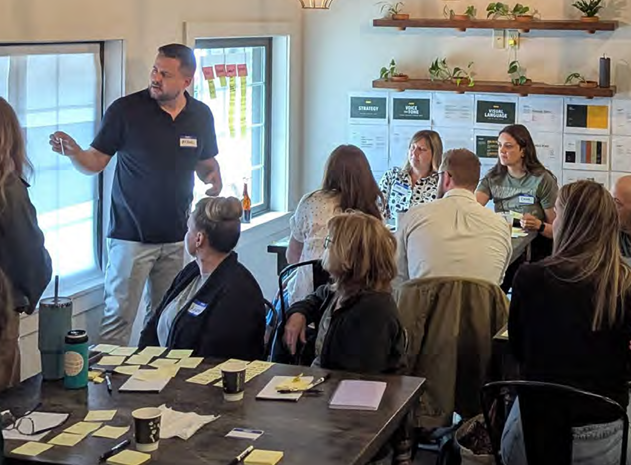 What traits define the division in the minds of its audiences? Participants crafted short, powerful statements beginning with “we are” that help further define exactly who NMU Extended Learning is.
The next step was to determine what the target audience would be. 50% would be non-typical learners. These people are people working full time, taking gap years, went the family route in life, etc. The other 50% was split in half, 25% are learners still in high school; dual enrolled, middle college students, concurrent. The last 25% are typical undergraduate students.
Following this came the marketing portion of the workshop weekend. The goal was to identify patterns, gather inspiration, and uncover opportunities to make NMU Extended Learning’s communications more engaging, emotionally resonant, and aligned with the expectations of the division’s diverse students. Participants looked at different advertisements in both still form and video form.
By the end of the brainstorm session the result was a shared direction and clear next steps for NMU Extended Learning to stand out in the competitive landscape; where Northern will be the hub for the Upper Peninsula’s non-typical learners.
Scaling the Results
With the launch of NMU Evergreen, Northern Michigan University has established a permanent, flexible hub for non-traditional learners seeking professional growth. By scaling these online degrees and workforce training programs, the university provides a seamless bridge between real-world experience and academic credentials.
This initiative ensures that every Wildcat has access to a lifelong educational pathway that adapts to their unique schedule. Everyone deserves the option to continue their education. A higher education offers the ability to get that promotion, land that dream job, or help you finally open that new business that is destined to succeed. That’s what Evergreen is, an opportunity to build.
Moving Mindfully: NMU's Sustainable Move-In/Move-Out Program
By: Daniel Wolski
NMU Vision: Like the lake that inspires us, Northern Michigan University will be known as Superior, in the ways we support our people, partner with our place, and realize the potential of all our students.
This article is part of a series highlighting progress on Our Compass, NMU's strategic plan. Strategy 1.4 challenges us to embed sustainable values across curriculum, operations, and partnerships. Here is what that looks like in practice.
A Problem Worth Solving
Northern Michigan University has long been committed to building a sustainable campus. From composting food waste to NMU Catering switching to recycled plates, napkins, and cups, the university has been actively working toward its goal of reducing waste. But what about the surge of waste that happens twice every year, when thousands of students move in and move out? That is the question a new initiative set out to answer: the Move-In/Move-Out program.
It takes a team for a great idea to come to life. Launched in 2025, the Move-In/Move-Out program brought together a cross-departmental task force spanning the Sustainability Hub for Innovation and Environment (SHINE), Housing and Residence Life, and Facilities Operations. The goal was straightforward: address the waste that comes at the beginning and end of every academic year, and replace disposal with diversion.
The Move-In Results
The numbers speak for themselves. Several roll-off dumpsters designated exclusively for recycling were placed across campus during the 2025 move-in. Volunteers from NMU and the broader Marquette community helped students and families sort materials and learn how to continue recycling throughout the year. The result was 8.76 tons of recyclable material diverted from the landfill, all transported to Recycle 906 to be processed and repurposed into new products. That is what a baseline year can look like.
When the school year ends, the challenge shifts. Mini fridges, lamps, clothes, mirrors, and small appliances that still have plenty of use left in them would otherwise end up in a dumpster. The Move-Out program gives those items a second life. Students can attend Stuff Swap events on the last two weekends of April, to donate and/or browse locations across campus between 11:00 a.m. and 5:00 p.m.
A Community Effort
NMU does not do this alone. The program partners with the Marquette Ripple Effect, a local nonprofit that connects NMU students with basic living needs including clothing, bedding, and food, while fostering goodwill between campus and the surrounding community. Items not claimed at Stuff Swap find their way to other local partners including Packrats and the Salvation Army. Usable mini fridges are redistributed across campus offices or made available for free, ensuring as little as possible ends up in a landfill.
What Is New in 2026
The task force is not slowing down. Updated magnetic signage on the green roll-off dumpsters will more clearly communicate what belongs inside and what should be donated instead. Battery collection will be available for the first time. Volunteer coverage is expanding, with sign-up opportunities through the Center for Student Enrichment for students seeking Superior Edge credit. Each addition reflects a simple philosophy: layer improvements year over year rather than overhauling everything at once.
Whether you are a student heading home for the summer, a staff member looking to get involved, or a community member who wants to give a good item a new home, there is a role for you in this effort. To learn more, find Stuff Swap locations, and sign up to volunteer head over to the SHINE website. Together, small decisions during move-out week add up to something much larger than a clean residence hall room; it leads to a cleaner and greener Marquette.
Rest, Grow, Lead: NMU's Week of Purpose
By: Daniel Wolski
NMU Vision: Like the lake that inspires us, Northern Michigan University will be known as Superior, in the ways we support our people, partner with our place, and realize the potential of all our students.
This article is part of a series highlighting progress on Our Compass, NMU's strategic plan. Strategy 1.4 challenges us to embed sustainable values across curriculum, operations, and partnerships. Here's what that looked like in March.
Values In Action
What does it look like when a university lives and acts by its values? When other schools simply write them down and hide it on the website, one school does not just write them down, it lives them out loud. From March 25 to 27, 2026, Northern Michigan University hosted the United Conference. For three days, the theme of Rest: Reclaiming Power Through Resilience and Resistance was kept in mind. Through speeches, workshops, presentations, and keynote speakers, professors, students, staff, and professionals came together to converse and unite.
This is strategy 1.4 in motion, sustainability embedded not just in one program or department, but across curriculum, operations, and community partnerships all at once. PEAK26 and the Campus Sustainability Summit came together with other initiatives under one umbrella to create the United Conference. Peak26 is a “professional development conference centered on skill-building, collaboration, and helping you climb toward your next level of success”. NMU’s SHINE program hosted the Sustainability Summit which “events form a dynamic ecosystem that uplifts wellness, leadership, sustainability, and equity, inviting every student, employee, and community member to learn, lead, and thrive together”. Common Reader Program, the Wildcat WellBeing Fair, Poetry Without Borders, and the inaugural UNITED - KCP 4S Student Conference rounded out a week designed to leave no corner of campus life untouched.
Rest: Reclaiming Power Through Resilience and Resistance. That was the theme that was the core of the conference for the three days. This theme frames rest as a radical, transformative practice that connects personal well-being with social change. Rather than viewing rest as downtime, the initiative encourages the NMU and U.P. community to see it as a form of collective action. A way to reclaim energy and agency from systems of constant productivity. This idea serves as the foundational thread for the entire event, integrating self-care into academic sessions, sustainability efforts, and community wellness circles to show that personal restoration is essential for long-term resilience and effective leadership.
United Together
What made the conference so successful was the people who showed up. Students, faculty, staff, community members, authors, and professionals united together to educate and learn from one another. With breakout rooms, author book signings, keynote speakers, and more, engaging in the theme was an easy task. From presentations for local projects like The Northern Woodshed Project to educational breakout sessions about AI data centers being built in the northern Midwest region, there was something for everyone.
The conference touched on all eight of NMU's core values: community, opportunity, rigor, environment, inclusion, connection, innovation, and wellbeing. It also advanced Strategy 1.4 of Our Compass, which challenges NMU to embed sustainable values across curriculum, operations, and partnerships. UNITED did not treat sustainability as a standalone topic. It wove it into leadership development, wellness, cultural dialogue, and academic inquiry simultaneously. When a strategic plan stops being a document and starts being a lived experience, that is when you know something real is happening at an institution.
Why It Matters
It would be easy to look at a packed three-day schedule and see a collection of events. But what happened last month was something more deliberate. It was NMU modeling, in practice, what it means to partner with our place, support our people, and realize the potential of all our students.
Sustainability is not just a recycling program or a solar array. Leadership is not just a résumé skill. Wellbeing is not something you find only at the health center. When you bring all of that into the same building, the same week, under the same theme, people start to see how it connects. That connection is what Northern is building. One summit, one pitch, one shared conversation at a time.
Evergreen: The Lifelong Learning Ecosystem
By: Daniel Wolski
NMU Vision: Like the lake that inspires us, Northern Michigan University will be known as Superior, in the ways we support our people, partner with our place, and realize the potential of all our students.
This article is part of a series highlighting progress on Our Compass, NMU's strategic plan. Strategy 3.3 meets learners where they are throughout their lives. Here's what Evergreen looks like now that it's out of the planning room.
An Idea Becomes an Initiative
Not long ago, Evergreen was a wall of sticky notes and a shared sense that Northern could do more for the learners who do not arrive at eighteen and leave at twenty-two. On September 9 and 10, 2026, it became real.
The Division of Extended Learning and Community Engagement welcomed faculty, staff, students, and community partners to Peninsula 2 at the Northern Center for two days of presentations and working sessions. Rooted in Northern's spirit and tradition, NMU Evergreen is the university's enduring commitment to lifelong learning for students, alumni, and the community.
Day One: Learning from the Field
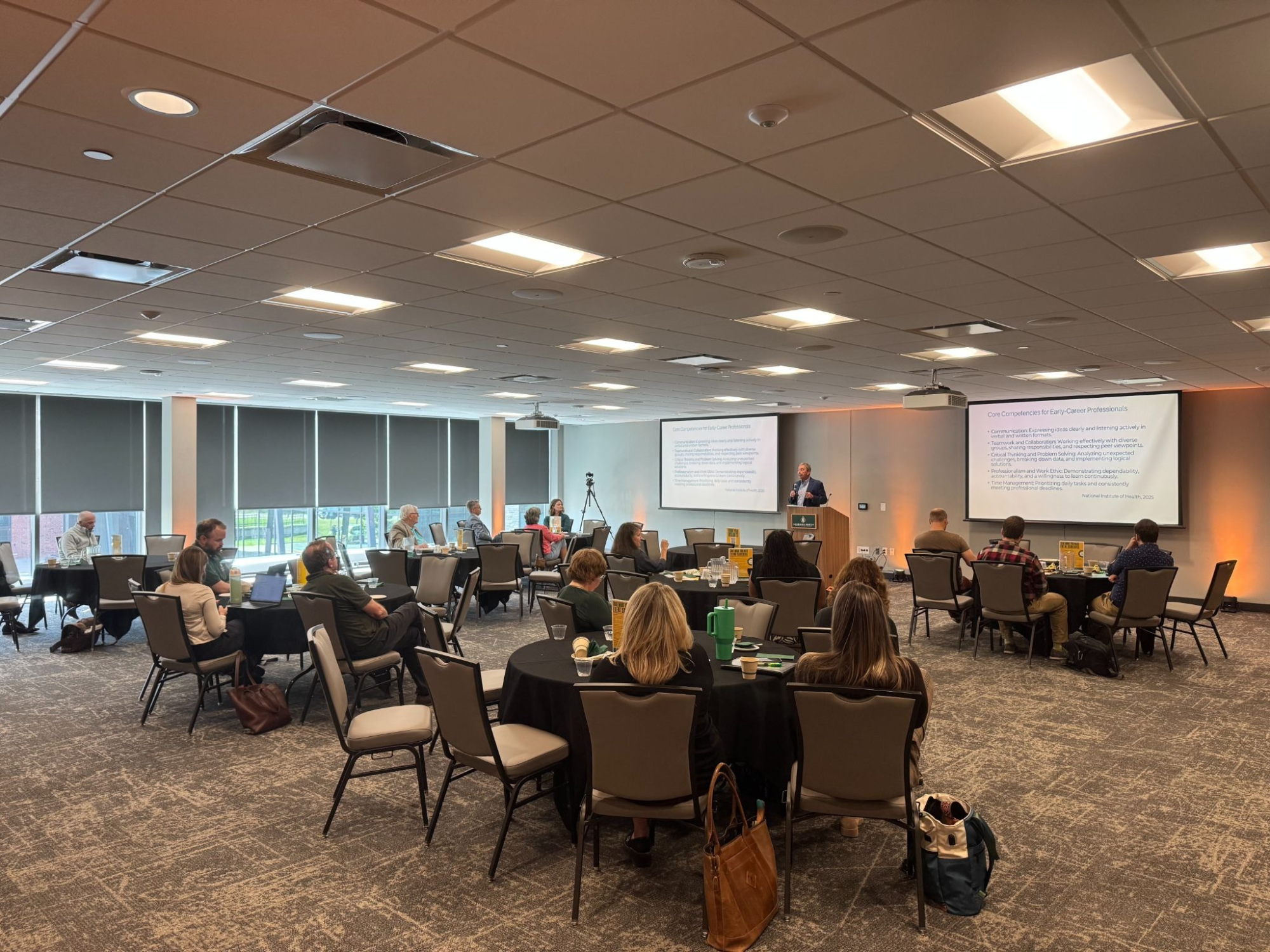 President Olsen opened the first afternoon, and the podium then went to voices from beyond Marquette.
Jeremy Hendges of the Michigan Center for Adult College Success brought the statewide view. Michigan is home to a large population of adults who earned credits and never finished, and closing that gap has become a priority far bigger than any one campus.
Dr. Chris Dede followed. He wrote The 60-Year Curriculum, the book behind a phrase Northern has used for years. Having the author in the room to talk through it was a rare opportunity. Dr. David Schejbal, president of Excelsior University, closed the day with the perspective of an institu- tion that has served adult learners for decades.
“Higher education needs to implicate more application based learning”
-Dr. David Schejbal
Three speakers, three vantage points: the policy landscape, the framework, and the long track record.
Day Two: Northern's Turn
Interim Provost Dr. Robert Winn opened the second day, and the conversation turned toward home.
Dr. Steve VandenAvond, Associate Provost for Extended Learning, joined Dr. Brad Hamel, Executive Director of the Global Campus, and Stephanie Zadroga-Langlois, Director of Continuing Education and Workforce Development, to lay out what the 60-year curriculum looks like with Northern's catalog, staffing, and students attached to it.
Two sessions followed that carry a great deal of weight. The first covered micro-credentials and Learning and Employment Records, the tools that let a short program show up on a record an employer can read and a learner can build on later. The second, led by Dr. VandenAvond, covered Credits for Prior Learning, which gives academic credit for skills a person already brings through the door. A paramedic with a decade on the job, a welder with a shop full of hours, a veteran with years of technical training: prior learning is the difference between starting over and picking up where they left off.
The two days closed with an industry partner panel in the Founders Room, moderated by David Nyberg and bringing together regional employers and accessibility experts. It was the right conversation to end on. Credentials matter most when they match the jobs waiting in the Upper Peninsula.
Built Around Real People
Evergreen is built around the learners it serves, not the offices that run it. The same three stories come up again and again. There is the learner who earned credits at Northern and stepped away before finishing, and now has the work experience to make that degree mean something. There is the learner carrying coursework from two or three institutions who wants every credit to count toward graduation. And there is the learner building a degree while staying close to home, holding a job, and raising a family. Evergreen exists to give each of them a route, backed by more than a century of Northern serving students of every age and background.
Graduates have been walking those routes for years. They stepped away from school to raise families and came back for a credential in a field that did not exist when they left. They stacked an associate's degree from a community college downstate onto a bachelor's here. They finished at Northern, built a career somewhere else, then returned to prepare for a second one. Those graduates are now working in cybersecurity, veterinary medicine, regional economic development, and the industries that keep the Upper Peninsula running. None of their paths run in a straight line. That is exactly the point.
After pausing her education to raise a family, Sarah Hagle used NMU’s U.P. Cybersecurity Institute to relaunch her career, earning her degree in Cyber Defense and securing a full-time role as a Cybersecurity Analyst. Her story is proof that starting over isn't a setback, it's a step forward.
Why It Matters
Strategy 3.3 of Our Compass asks Northern to meet students' educational needs throughout their lifetime by building flexible pathways and credential options. Evergreen is that strategy with a name, a website, and a team behind it helping non-traditional students succeed at every step of their educational journey.
Education is not confined to one season of life. It is something a person can return to, add to, and build on. A promotion, a career change, a business that finally opens its doors: those things start with someone deciding they are not finished learning. Northern's job is to make sure the door is open when they come back.
Learning never stops. Neither do you.
Bring it North.
To explore programs or request information, visit evergreen.nmu.edu. Questions about the Evergreen initiative can go to Andrea Marsh at amarsh@nmu.edu.